

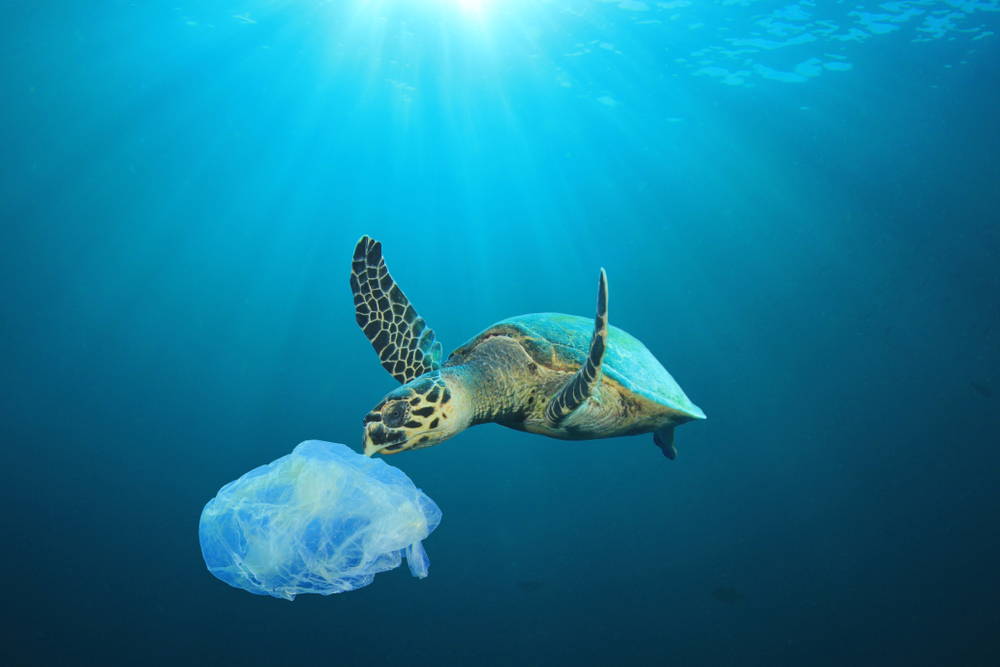

Never before has the aversion to plastic been so great. The year 2018 brought with it a forceful uproar against the all-purpose material. It was the year of shocking images of plastic beaches and on plastic animals that died, it was the year with sophisticated Projects against the flood of plastic and the year in which even political action was taken against plastic. But a new movement has long since washed ashore - a counter-movement that questions whether plastic really is as bad as is claimed everywhere. We at HALM want to clear up the trivializing arguments for the use of plastic.
MYTH 1: "WE IN GERMANY ARE NOT TO BLAME FOR THE PLASTIC WASTE IN THE OCEANS. THAT'S WHY OUR PLASTIC CONSUMPTION IS NOT A PROBLEM."
` geographical location their relatively weak economic strength and their location by the sea poorly developed recycling facilities would apparently have to be held accountable for the entire problem. However, on closer inspection, there are often simple explanations for seemingly inexplicable statistics. According to European Environment Agency for example, the European Union exported in 2019 150,000 tons of plastic waste per month out of the EU. This should mean that Germany for the waste problem in Asia partly responsible be. These countries are often emerging economies where avoiding plastic waste is not yet the top priority. Problems such as clean drinking water and wastewater treatment are higher up on the list.

What matters is that the Plastic problem is not solved by pointing the finger at others and us Blame assignments push over. Technologies against marine litter are to be exported to emerging countries anyway to help them deal with the flood of plastic. Straight we have financial and political opportunities, to combat the problem. Moreover, a lower proportion of plastic consumption does not justify continuing to use the environmentally harmful material.
"It's only one straw!" (said 8 billion people)
The less plastic waste is produced and thrown away, the better. It is important that every single one does its part.

MYTH 2: "RECYCLING WORKS IN GERMANY, SO WE CAN USE PLASTIC PRODUCTS WITH A CLEAR CONSCIENCE."
Even the best recycling system cannot solve the problem of the increasing amount of waste in Germany solve. In a global comparison, Germany ranks Place 4 among the largest waste producers in the ranking with 127.800 tons Waste per day. Resource consumption is far too high. This is exactly where action should be taken to prevent enormous amounts of waste from being generated. But our highly touted recycling rates may be called into question at this point. The quotas look primarily at what and how much goes into the recycling plants. But what they make from the waste and how efficiently that works plays no role in the statistics. Less than half of the plastic waste is recycled; the rest is burnt. A concrete example would be mechanical-biological treatment plants that, for instance, sort household waste. However, these plants primarily recover metals. Plastic or paper contained in household waste is often so contaminated that it is only suitable as fuel. Yet this amount is also included in the official recycling rate because it passes through a recycling plant. That is exactly what creates a false impression of our recycling processes.
MYTH 3: "THE ENVIRONMENTAL FOOTPRINT OF GLASS BOTTLES IS WORSE THAN THAT OF PLASTIC BOTTLES."
Actually, there is currently one problem with the environmental footprint of glass bottles: many water brands have a single source and transport their water from there over hundreds of kilometers to their destinations. This increases CO2 emissions and contributes to a poorer environmental footprint. But fundamentally, the glass bottle as a reusable product is the more environmentally friendly version. It would therefore make more sense to address the root of the problem directly, rather than the point where things are already going wrong. Our mobility is still based on fossil conditions, but it is changing. In the medium term, transport will be electric and in that respect the CO2 footprint for mobility inevitably decline. This is precisely the point at which increased investment should be made so that mobility does not become the undoing of the glass bottle’s success. Simply because plastic is made from fossil raw materials, the possibility of using it is finite. In this respect, it makes sense to work toward using alternatives as quickly as possible starting today. It cannot be a solution to rely on an environmentally harmful product like the plastic bottle simply because progress in sustainable mobility is not moving fast enough.

MYTH 4: "MICROPLASTICS
IS NOT HEALTH-
HARMFUL."
Microplastics are on everyone’s lips. And not just figuratively. It all began with findings in fish, which absorb microplastics through polluted seas. Microplastics have long since seemingly been found everywhere: In the Drinking water, in land animals and now even in the human body. The problem is that, due to the lack of experience with microplastics, there are still no official limit values. At present, measurements are often still below the limit values set for comparable pollutants. In addition, research on microplastics is still in its infancy. Since findings have only now been detected in animals and humans, it is not yet possible at this point to say how the plastic will affect our bodies in the long term. But that is no reason to sit back, because plastic consumption is rising rapidly worldwide. This will inevitably also increase the proportion of microplastics in our Nutrition and thus increase in our bodies. At this point in time, the measured values still seem tolerable. But if plastic consumption remains the same or even increases, these values too will eventually reach a harmful to health rise. There are already initial warning signs, such as the phenomenon of Chalk teeth, which is suspected to be triggered by plasticizers contained in plastic.
SUMMARY
Summing up, it is clear that the arguments in favor of plastic often appear very compelling and sometimes create the impression that the negative headlines about the flood of plastic are exaggerated. Research still has not reached its goal, and some issues surrounding the topic of plastic (for example microplastics) have still not been fully clarified. What is certain, however, is that although plastic is a practical all-purpose material, on many levels it is a proven danger for Human, Animal and Nature represents. Every piece of plastic that is not requested and is, every plastic packaging that is replaced by sustainable packaging, and every glass bottle that you fill instead of a disposable PET bottle will help in the long term to contribute to the Plastic Madness Step by step to counteract. So next time you shop, remember the Jute bag, take a HALM for restaurants with, where there are only plastic straws, and more often visits a Zero-waste shop. Because Together only can reduce our high plastic consumption.
Share:
The perfect sustainable wedding:ecological weddings with HALM
Sustainable gift ideas for Christmas